Fundamental Forces
If matter provides the letters of nature, the fundamental forces supply its grammar. Particles do not exist in isolation: they sense each other's presence through certain properties – mass, electric charge, colour charge – and thereby exert forces on one another. Modern physics distinguishes four fundamental forces. Three of them are described by the Standard Model; the fourth, gravity, remains an open question to this day.
Gravity
Gravity is the most familiar force in our everyday lives, yet the weakest of all four. It acts exclusively as attraction and couples to mass. On large scales – planets, stars, galaxies – it is dominant, simply because mass accumulates enormously on cosmic scales. At the scale of atoms and particles, its effect is completely negligible compared to the other forces.
The best description of gravity is Einstein's general theory of relativity, which treats mass and energy as a curvature of spacetime. A quantum-mechanical description of gravity – analogous to that of the other three forces – does not yet exist. The hypothetical force-carrier, the graviton, has not been experimentally detected to date.
Electromagnetic force
The electromagnetic force is many orders of magnitude stronger than gravity. It acts both attractively and repulsively, depending on the signs of the charges involved: like charges repel, opposite charges attract. On large scales, matter neutralises itself: positive and negative charges balance each other, so the net electromagnetic force effectively vanishes at macroscopic distances.
Yet this is the force that shapes the world around us. It binds electrons to atomic nuclei, underpins all of chemistry, and is responsible for light, radio waves, and X-rays. Its theoretical description – Maxwell's classical electrodynamics and its quantum version QED (quantum electrodynamics) – is one of the most precisely tested theories in all of science. The force-carrier is the photon – massless and with infinite range.
Weak interaction
The weak interaction is the least intuitive of the four forces. It operates only at extremely short distances – roughly m (thousands of times smaller than an atomic nucleus) – and couples to a property known as weak isospin. Its most visible effect is beta decay: the conversion of a neutron into a proton (or vice versa), with the emission of an electron and an antineutrino.
Enrico Fermi developed the first quantitative theory of this decay in 1934 – four years after Pauli's proposal of the neutrino. The associated force-carriers – the W⁺, W⁻, and Z bosons – were first experimentally confirmed only in 1983 at CERN. What makes this force unique in the Standard Model: its force-carriers are massive, which immediately explains why its range is so extremely limited. The heavier the force-carrier, the shorter the distance it can be exchanged.
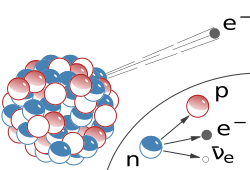
Beta-minus decay at the quark level. A down quark inside the neutron emits a virtual W⁻ boson and becomes an up quark, turning the neutron into a proton. The W⁻ immediately decays into an electron (e⁻) and an electron antineutrino (ν̄ₑ).
Adapted from Inductiveload, Public Domain, via Wikimedia Commons.
Strong interaction
The strong interaction is the most powerful force in nature. It binds quarks together inside protons and neutrons, and at a higher level also holds protons and neutrons together inside the atomic nucleus. The property it couples to is colour charge – a quantum-mechanical property that has nothing to do with visible colour but was named that way by convention. There are three colour charges (red, green, blue) and their counterparts (antired, antigreen, antiblue).
A crucial feature of the strong force is that it grows stronger as two colour charges are pulled further apart – completely unlike gravity and electromagnetism, which weaken with distance. When a quark is pulled away from a proton, the energy rises until a new quark–antiquark pair is spontaneously created. This directly explains why free quarks are never observed: colour confinement is not a coincidence but an inevitable consequence of how the strong force works.
At very short distances (high energy), the strong force actually becomes weaker: quarks can then behave almost as free particles. This is called asymptotic freedom. Together, asymptotic freedom (short distance) and colour confinement (longer distance) form the characteristic twofold behaviour of the strong interaction.
This neutralisation condition also explains the hadron rule. The most stable colour singlets are three quarks (red + green + blue = white), three antiquarks, or a quark–antiquark pair. Exotic multi-quark configurations with four or five quarks have been experimentally observed, but are generally extremely short-lived. The force-carrier of the strong interaction is the gluon – massless, but – unlike the photon – itself also a carrier of colour charge, so gluons can interact with each other.
Force-carriers: bosons as messengers
In quantum mechanics, forces are not transmitted via a field in the classical sense, but by the exchange of virtual particles – the force mediators. These are all bosons.
| Force | Carrier | Mass | Range | Example |
|---|---|---|---|---|
| Electromagnetic | Photon (γ) | 0 | Infinite | Light, chemical bonding |
| Strong | Gluon (g) | 0 | ~10⁻¹⁵ m | Quarks in proton/neutron |
| Weak | W⁺, W⁻, Z | 80–91 GeV | ~10⁻¹⁸ m | Beta decay |
| Gravity | Graviton (?) | 0 (?) | Infinite | Planetary orbits |
The fact that W and Z bosons are so heavy (~80 and ~91 GeV) while photons and gluons are massless is not self-evident. Explaining these mass differences requires the Higgs mechanism – which we discuss in chapter 7.