Building Blocks of Matter
Internal structure of nucleons
For a long time, protons and neutrons seemed to be the deepest layer of matter. But here too, evidence for a richer internal structure began to accumulate. The neutron is electrically neutral, yet has a measurable magnetic moment – something impossible for a true point particle with no internal charge distribution. The first particle accelerators of the 1950s and 1960s also uncovered a whole series of short-lived resonances of the proton and neutron: excited states, analogous to the way an electron in an atom jumps to a higher energy level.
The conclusion was unavoidable: protons and neutrons themselves have an internal structure. The constituents within them were called quarks.
Quarks: confined but never free
A striking difference from atoms makes quarks unique. In an atom, an electron can acquire enough energy to escape – the atom ionises. Nucleons work differently: quarks can reach higher energy states, but they never escape. To this day, no free quark has ever been observed. They are permanently confined within a space smaller than m – a phenomenon known as colour confinement (color confinement).
The interactive visualisation below makes this tangible. It shows a quark (q) and an antiquark (q̄) bound together by a colour flux tube – a tube-like region of strong-force field energy. Drag the slider to pull them apart and watch what happens: the tube stretches, storing more and more energy, until it snaps. But instead of a free quark, a brand-new quark–antiquark pair pops out of the vacuum, and you end up with two mesons. No matter how hard you pull, you never isolate a single quark.
Drag the slider to pull the quarks apart. Watch the energy bar fill up – when it reaches the breaking point, the flux tube snaps and new quarks appear.
The definitive experimental confirmation of quarks came in the late 1960s through deep-inelastic scattering experiments at the Stanford Linear Accelerator Center (SLAC). Electrons with energies of tens of GeV (corresponding to wavelengths around m) were fired at protons and found to scatter off internal point-like structures – the quarks – analogous to how Rutherford had once seen alpha particles bounce back off the atomic nucleus. Two quark types were thus experimentally established:
| Quark | Charge | Mass | Spin |
|---|---|---|---|
| Up (u) | +2/3 e | ~2–3 MeV | 1/2 |
| Down (d) | −1/3 e | ~4–5 MeV | 1/2 |
With these two particles, the composition of the proton and neutron can be explained:
- Proton = uud → charge:
- Neutron = udd → charge:
Other quark combinations are also possible, but are unstable. The neutron itself is unstable outside an atomic nucleus and decays with a half-life of about 15 minutes. Inside a nucleus, a neutron can be stable when the nuclear binding energy makes beta decay energetically unfavourable: the decay cannot then reach a suitable final state, so the neutron remains bound and stable.
Quark masses versus nucleon masses
Something surprising: the masses of the individual quarks are considerably lower than those of the nucleons they form.
| Particle | Mass |
|---|---|
| Up quark | ~2–4 MeV |
| Down quark | ~4–5 MeV |
| Proton | 938.3 MeV |
| Neutron | 939.6 MeV |
The sum of the quark masses (~10 MeV) is only a small fraction of the proton mass (938 MeV). The vast majority of the mass of ordinary matter therefore comes not from the quarks themselves, but from the enormous binding energy of the force fields that hold them together – once again a manifestation of . The neutron is slightly heavier than the proton, which is related to the slightly higher mass of the down quark. This is why a free neutron spontaneously decays into a proton.
Spin: fermions and bosons
Spin is an intrinsic property of an elementary particle – just like charge or mass – but with a quantum-mechanical character. It has no direct counterpart in classical physics, though it is sometimes compared to the spinning of a top.
Particles are classified according to their spin value. Fermions have half-integer spin (1/2, 3/2, …) and obey the Pauli exclusion principle: no two fermions can simultaneously occupy the same quantum state – electrons in an atom are the most familiar example. Bosons have integer spin (0, 1, 2, …) and are not subject to this prohibition; they can all occupy the same state.
Quarks and electrons are fermions (spin 1/2). Protons and neutrons are fermions too (their spins combine to 1/2). Particles with spin 3/2 also exist – the Δ-resonances – but they are extremely short-lived ( s) with a mass of ~1,200 MeV.
Antimatter
Every particle turns out to have an antiparticle: a mirror partner with the same mass but opposite charge. The antiparticle of the electron (charge −1) is the positron (charge +1). Quarks likewise have antiquarks, from which antiprotons and antineutrons can be assembled:
| Particle | Composition | Charge |
|---|---|---|
| Proton | uud | +1 |
| Antiproton | ūūd̄ | −1 |
| Neutron | udd | 0 |
| Antineutron | ūd̄d̄ | 0 |
When a particle meets its antiparticle, they destroy each other in a flash of pure energy – annihilation.
Hadrons: baryons and mesons
Quarks always appear in nature in bound configurations called hadrons. There are two main families:
- Baryons (fermions): three quarks () or three antiquarks (). The proton and neutron are the best-known examples.
- Mesons (bosons): one quark and one antiquark (). The pions (, , ) are the lightest mesons; they were theoretically predicted by Yukawa in 1935 and experimentally confirmed in 1947. Pions play a crucial role in holding the atomic nucleus together.
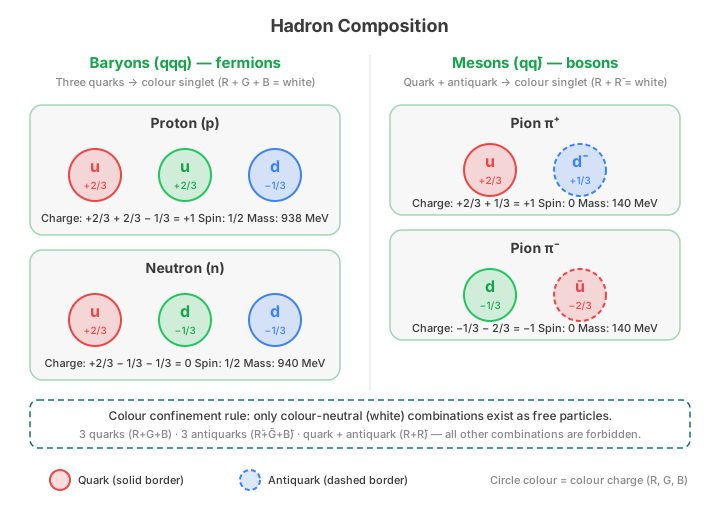
Hadron composition. Left: baryons contain three quarks whose colour charges (red + green + blue) combine to a colour-neutral singlet. Right: mesons contain a quark–antiquark pair. Antiquarks are marked with a dashed border. Only colour-neutral combinations exist as free particles.
Why this classification links to spin: a baryon contains three quarks, each with spin . Those spins combine to a total spin of or – half-integer values that classify baryons as fermions. A meson contains one quark and one antiquark, both with spin . These combine to spin (antiparallel) or spin (parallel) – integer values that classify mesons as bosons.
The fact that free quarks are never observed, and that baryons and mesons are the most familiar colour singlets, is not a coincidence – it follows from a deeper symmetry law of the strong force, which we discuss in the next chapter. Exotic hadron states such as tetraquarks () and pentaquarks () have been experimentally demonstrated, but are generally extremely short-lived.
The neutrino and beta decay
When a neutron decays – the so-called beta decay – an electron is emitted. But conservation of energy and momentum did not hold if only an electron was released. In 1930, Wolfgang Pauli postulated the existence of an invisible, neutral particle that carries away the missing energy: the neutrino.
Neutrinos are extraordinarily difficult to detect. They barely interact with ordinary matter – billions of neutrinos are passing through the human body right now without leaving a trace. The reason is that neutrinos interact almost exclusively via the weak interaction: their interaction cross-section is so small that the probability of a collision in human tissue is negligible.
The Sun produces neutrinos per second through its fusion processes; about neutrinos per cm² per second reach Earth, the great majority of them solar.