The Standard Model: Summary and Limits
The Standard Model is the theory that unifies all these building blocks and forces into one coherent framework. It is the most precisely tested scientific theory we possess. And yet it is unfinished.
What does the Standard Model describe?
The Standard Model describes two categories of particles. The fermions are the building blocks of matter: six quarks (up, down, strange, charm, bottom, top) and six leptons (electron, muon, tau, and their three associated neutrinos), each in three generations, together with all their antiparticles. The bosons are the force-carriers: the photon (electromagnetic), the W⁺, W⁻, and Z bosons (weak), the gluons (strong), and the Higgs boson.
Gravity – and the hypothetical graviton – lie outside the Standard Model.
The theory predicts the outcomes of particle collisions with a precision that sometimes matches measurement to ten decimal places. That is extraordinary. But it also has shortcomings.
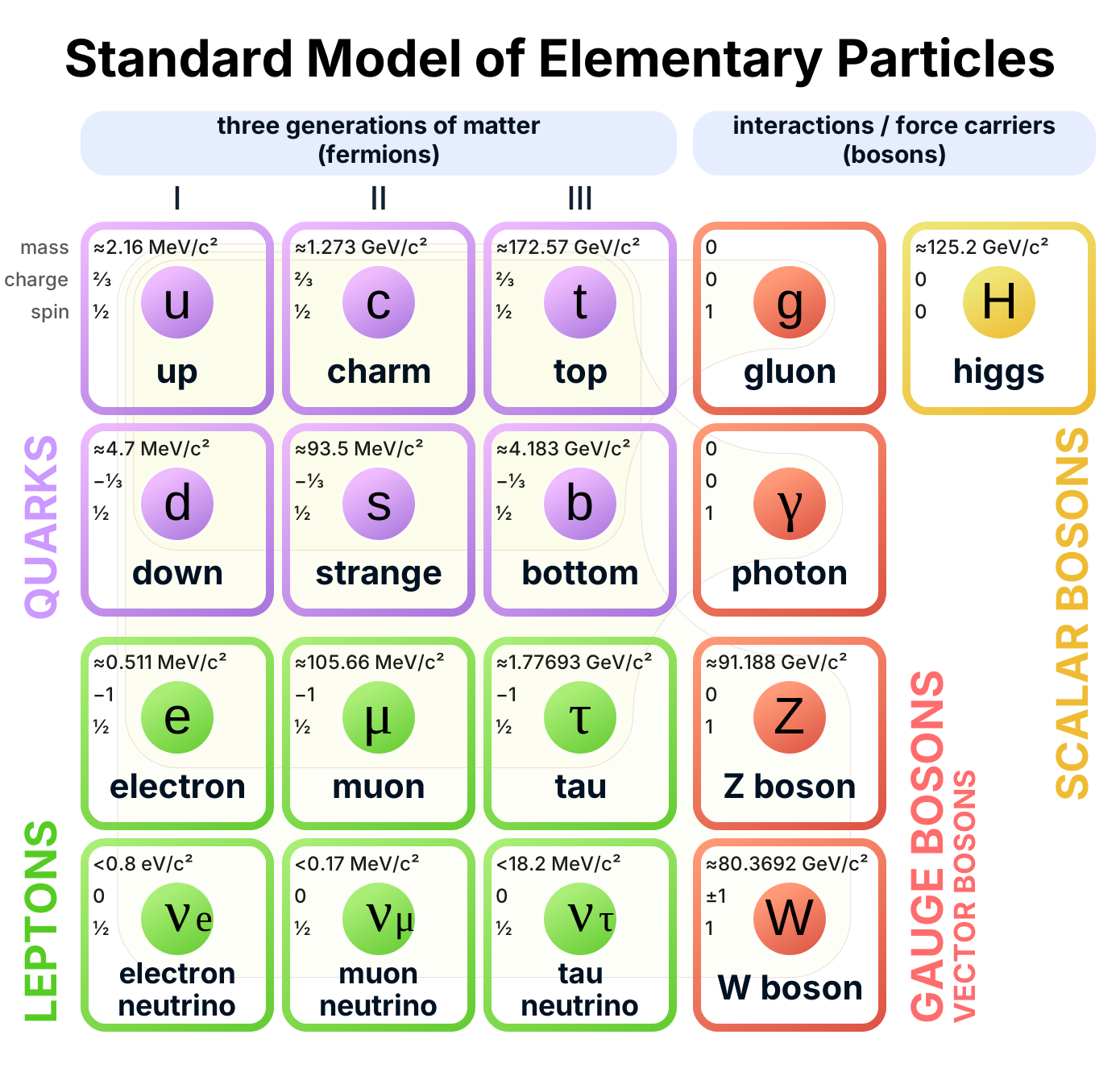
All elementary particles of the Standard Model, arranged by generation and type.
Adapted from MissMJ / Cush, CC BY 3.0, via Wikimedia Commons.
A fundamental problem: mass
The symmetry of the electroweak Standard Model does not permit direct mass terms for the W and Z bosons, nor for the fundamental fermions such as quarks and leptons: such terms would break that symmetry and render the theory mathematically inconsistent. This is a fundamental problem, because the W and Z bosons are indeed very massive (~80–91 GeV) and quarks and leptons are not massless either. The mass of protons and neutrons is a separate matter: that mass is dominated by the binding energy of the strong interaction (QCD), not by the Higgs mechanism. The theory was therefore structurally incomplete for the W and Z bosons and the fundamental fermions.
In 1964, three independent research groups proposed a solution: the Brout–Englert–Higgs mechanism, named after François Englert & Robert Brout (ULB), Peter Higgs, and Gerald Guralnik, C.R. Hagen & Tom Kibble. The idea: the universe is permeated by an invisible field – the Higgs field – that 'spontaneously breaks' the symmetry of the electroweak theory. Particles that interact with this field thereby acquire an effective mass. The stronger the interaction, the heavier the particle. Photons do not interact with the Higgs field and remain massless; W and Z bosons do – which is why they are so heavy.
Such a field requires an associated particle: the Higgs boson. The search for it became the greatest challenge in particle physics in the late twentieth century.
- The LEP experiment at CERN searched through the 1990s but did not find the boson.
- The Tevatron at Fermilab (USA) did not find it either.
- The LHC became operational in 2010, powerful enough to produce the Higgs boson.
- On 4 July 2012, the ATLAS and CMS experiments confirmed the discovery. Only 1 in 1,000,000,000 collisions produced the boson – a needle in a cosmic haystack. In 2013, Englert and Higgs received the Nobel Prize in Physics.
Unification of forces
One of the great ambitions of theoretical physics is to merge the four forces into a single overarching description. A first step was taken in 1961 by Sheldon Glashow: the electroweak unification, which shows that the electromagnetic and weak interactions are in reality two aspects of the same force – just as electricity and magnetism already were. At high energies (above ~100 GeV), they behave as one.
This principle extends to yet higher energies and temperatures. When the measured strengths (coupling constants) of the electromagnetic, weak, and strong interactions are plotted as a function of energy, the three curves slowly converge as energy increases. This is an important hint – though not proof – that at extremely high energies a further unification may be possible.
In the early universe, near the Planck scale (where typical lengths are m; the corresponding Planck time is s), it may have been so hot that all forces merged into a single primordial force – though that domain lies beyond our current, experimentally tested theories. The electroweak theory is tested in the multi-TeV regime of the LHC. A further unification with the strong force – the Grand Unified Theory (GUT) – and ultimately also with gravity, remains an open question.
Particle masses
The Standard Model does not predict what masses the fundamental particles have – those values must be measured experimentally and fed into the theory as input. This applies to all quarks, leptons, and bosons. It is one of the reasons the Standard Model is considered incomplete as a fundamental theory.
What the Standard Model does not explain
The Standard Model is impressive, but it is not a final theory. A number of major open questions remain unanswered:
| Question | Explanation |
|---|---|
| Gravity | The graviton is not included; a quantum theory of gravity is missing. |
| Dark matter | ~27% of the mass-energy of the universe consists of dark matter – an unknown type of particle not present in the Standard Model. |
| Dark energy | ~68% of the universe is dark energy, responsible for the accelerating expansion – entirely unexplained. |
| Matter–antimatter asymmetry | Why does matter exist at all? The Standard Model describes CP violation, but not enough to explain the full observed excess. |
| Three generations | Why are there exactly three families of particles? |
| Neutrino mass | Neutrino oscillations show that neutrinos have mass – something the basic Standard Model does not accommodate (this requires extensions, e.g. a seesaw mechanism). |
Closing words
The Standard Model is one of the greatest intellectual achievements in the history of science. It describes the building blocks of nature with a precision that no other theory can match. At the same time, the gaps in our understanding – dark matter, gravity at the quantum scale, the origin of the matter–antimatter asymmetry – are every bit as fascinating as the successes themselves.
The search is not over. New experiments at the LHC and its future successors, neutrino detectors deep underground, and telescopes mapping the early universe are all looking for the same thing: physics beyond the Standard Model.
Further Reading
- Polkinghorne, John – Quantum Theory: A Very Short Introduction (Oxford University Press) – Broad, accessible introduction; no mathematical background required.
- Close, Frank – Particle Physics: A Very Short Introduction (Oxford University Press) – Concise introduction to particle physics; ideal as a first exploration.
- Susskind, Leonard & Hrabovsky, George – The Theoretical Minimum: Classical Mechanics (Basic Books) – Mathematically grounded but approachable; builds formal mechanics step by step.
- Susskind, Leonard & Friedman, Art – The Theoretical Minimum: Quantum Mechanics (Basic Books) – Sequel to the above; introduces quantum mechanics with mathematical precision.
- Feynman, Richard P., Leighton, Robert B. & Sands, Matthew – The Feynman Lectures on Physics, Volume III (Caltech) – Classic standard reference on quantum mechanics; requires a mathematical background.