Particle Accelerators
Why go further?
At the start of the twentieth century, the picture seemed complete: matter consists of atoms, atoms contain electrons, protons, and neutrons. But questions quickly accumulated. The magnetic moment of the proton and neutron did not behave as expected for true point particles. Free neutrons proved unstable and spontaneously decayed into protons. And in cosmic rays – high-energy particles that continuously hammer the Earth's atmosphere – entirely unexpected particles were discovered: muons, pions, and particles with a new property that physicists dubbed 'strangeness'.
All of these clues pointed in the same direction: there must be even deeper, more fundamental building blocks. To find them, scientists needed instruments capable of probing the smallest possible scales. As we saw in the previous chapter, that requires high energy. The solution: the particle accelerator.
Types of accelerators
A particle accelerator brings charged particles to high speed by exposing them to electric fields. How those fields are arranged determines the type of accelerator.
Linear accelerator (linac) The simplest setup: particles are produced in a source and then accelerated along a series of cylindrical electrodes that alternate in polarity. Each transition gives the particle an additional energy kick. Linear accelerators are compact and are often used as injectors for more powerful ring accelerators.
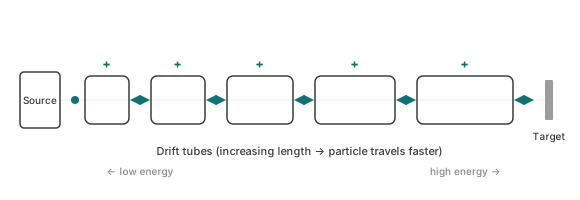
Linear accelerator. The drift tubes are connected to a voltage that alternates polarity in step with the particle's motion. Each time the particle crosses a gap, the field points in the direction that accelerates it – shown by the bright arrows; the dim arrows indicate the reversed direction. The tubes grow longer farther along the track because a faster particle travels more distance while waiting for the next gap.
Cyclotron In a cyclotron, particles are accelerated in the electric field between two D-shaped magnets. Those same magnets bend the particle's path into a spiral. The particle gains energy with each revolution and spirals outward until it reaches the edge and is extracted. Cyclotrons are still widely used – including for the production of radioactive isotopes in medicine.
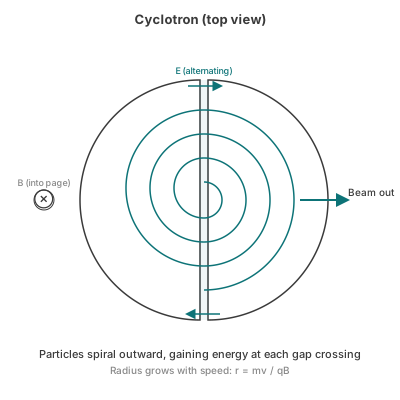
Cyclotron (top view). A magnetic field perpendicular to the plane bends particles into semicircles inside two D-shaped electrodes. The particles gain energy each time they cross the gap, spiralling outward until extraction.
Synchrotron In a synchrotron, particles move in a fixed circular orbit. They are accelerated in straight sections and steered by powerful magnets on the curves. As the particles speed up, the magnetic field increases to keep them on track. A side effect: accelerating charges in a bend emit electromagnetic radiation – the so-called synchrotron radiation. Facilities such as SOLEIL (near Paris) exploit this radiation as an extremely powerful light source for materials research, biology, and chemistry. Other synchrotrons, such as the former LEP and the current LHC at CERN, are built specifically to give particles as much energy as possible and collide them at defined points.
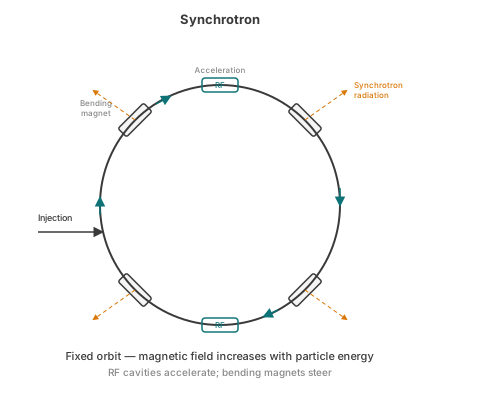
Synchrotron. Particles follow a fixed circular orbit. RF cavities on the straight sections provide energy; bending magnets at the curves steer the beam. The magnetic field is ramped up as the particles accelerate. Synchrotron radiation (amber dashes) is emitted tangentially at each bend.
The Large Hadron Collider (LHC)
The LHC at CERN in Geneva is the world's most powerful particle accelerator. Two beams of protons race in opposite directions around an underground ring 27 km in circumference and collide at four points with an energy of 6.8 TeV per beam – 13.6 TeV per collision in total (Run 3, started in 2022). For comparison: that is roughly the kinetic energy of a flying mosquito, compressed into a space smaller than a proton.
At the four collision points there are as many detectors, each designed for specific research questions:
- ATLAS and CMS are similar in concept and target a broad spectrum of collision products, including the Higgs boson and possible new particles.
- LHCb studies the difference in behaviour between matter and antimatter.
- ALICE analyses collisions between heavy ions (such as lead nuclei) to understand the state of matter at extreme density and temperature.
The ATLAS detector gives a sense of the scale: 46 m long, 25 m in diameter, and 7,000 tonnes in weight – comparable to the Eiffel Tower, yet suspended in an underground cavern. It was partly thanks to ATLAS that in 2012 the Higgs boson was discovered: the last missing building block of the Standard Model. The next major step is the High-Luminosity LHC (HL-LHC), planned for ~2029: not higher energy, but a factor of five to ten more collisions per second – making rare processes statistically accessible that are currently still hidden.